Search This Blog

Friday, April 19, 2019

Red-wattled Lapwing loses to the Daman. Mount Abu

Nature taking its toll 'Survival of the fittest'

The birds defended their nest for over a week after the initial surprise attack by the Daman caught them off guard it swallowed 2 eggs, a few days ago it swiped one more egg. Today 12 April 2019 it finally got the last remaining egg. It was painful to watch the Red-wattled lapwings fighting to save its eggs at the cost of almost losing their own lives. A group of passerby was on the verge of stoning the Daman on its last foray for the solitary egg that had survived. I had to shout and stop them from their wanton act of inter fearing with the dictates of nature. The photographs and the small video I've posted says it all. 

Red-wattled Lapwing - Vanellus indicus


Red-wattled Lapwing - Vanellus indicus


Red-wattled Lapwing - Vanellus indicus TRYING TO ATTACK DAMAN

Daman or Rat snake

This short video says it all.
⇓⇓

The final drama between the  Red-wattled Lapwing and the Daman


Tuesday, April 09, 2019

The Impending Woes: Forest Fires in Mount Abu.

“The tinderbox stands primed—one spark could trigger disaster.”
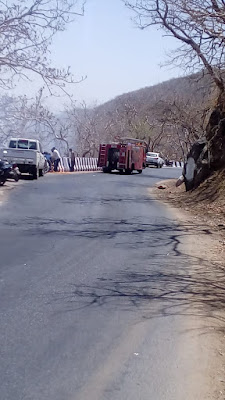

"Firefighters pressed into service to tackle the forest fire."
Firefighters pressed into service


Wildfire in Mount Abu Forest on the way to Abu Road

"Forest fire spreading through the hills of Mount Abu"
Fire on the Mountain

 The drive down Abu Road yesterday was anything but ordinary. A steady stream of vehicles climbed uphill with urgency—forest department jeeps, fire brigade units, and private water tankers—all converging toward a wildfire reported near Chippaburry. The mountain, once again, was under threat.

 But this is no longer surprising. It is becoming seasonal.

 A winter of poor rainfall has left Mount Abu exposed. The undergrowth has dried to a crisp, the soil has lost its moisture, and the vegetation—once resilient—is now reduced to kindling. Add rising temperatures, erratic winds, and prolonged dry spells, and the forest resembles a waiting hazard rather than a living ecosystem.

 And yet, year after year, we behave as though fires are accidents.

 They are not.

 These are the expected results of neglect, such as uncontrolled tourism, poor waste disposal, and a lack of strict enforcement on roads and at forest borders. Cigarette butts tossed without thought, glass bottles left behind to trap sunlight, and unchecked human movement through sensitive areas—these are not isolated acts. They are part of a pattern.

 Mount Abu has seen repeated forest fires over the years, but preparedness still feels reactive rather than preventive. While frontline staff risk their lives in harsh terrain—steep slopes, shifting winds, and limited access—the larger question remains: are they being supported?

 DFO Balaji Kari and his team have been preparing for months, anticipating such outbreaks. Their efforts on the ground deserve recognition. However, enhanced departmental preparation, including superior equipment, a larger workforce, and collaborative planning among the Forest Department, local government, and tourism bodies, is essential to match this stronger structural support.

 Because the pressures are only increasing.

 This summer, Abu faces a convergence of challenges—water shortages, deteriorating roads, and a surge in tourist footfall. Each of these strains the landscape further. A forest fire, in this context, is not just an isolated crisis—it is a symptom of cumulative stress.

 Accountability remains diffused.

 When regulations are lax and deterrence is lacking, the responsibility unnoticeably transfers to the least capable individuals, namely, field personnel and nearby communities. The same Abuites who, once again, stepped forward to help contain the fire alongside officials. The field staff and local residents make commendable contributions, but policy should not rely on them as a substitute.

 Because at its core, this is no longer just about fire.

 It is about how Mount Abu is being managed—or mismanaged—when ecological fragility is at its peak.

 The mountain is giving us clear signals.

Dry forests. Shrinking water sources. Rising incidents.

The question is no longer whether another fire will occur.

It is whether we will continue to meet it with reaction, or finally respond with foresight.


Sunday, April 07, 2019

Red-wattled Lapwing NO match for the Daman Snake Mount Abu

Red-wattled Lapwing is NO match for the Daman Snake 

6 April 2019.

I have been observing the Red-winged lapwings for a little over a week. This year she changed her nesting site. The birds have been constantly vigilant in chasing away the mongoose, the stray dogs that pass by, and the raptors that approach too close. They avoid the few cats that roam this area. 
Yesterday the ruckus the pair created caused a small flock of lapwings to appear out of nowhere got my curiosity I immediately grabbed my camera and went out to investigate. The birds were battling a losing battle against a nine-foot Daman that had sneaked upon the mother sitting on her eggs. 
All the ruckus and the feigning by the birds to draw the snake away from the eggs failed. It filled me with rage and wanted to intervene, but then held back letting nature take its course. I saw the snake swallow two eggs and then all hell broke loose one bird pecked the snake on the crown of its head, and two others moved in dangerously close to attack. The snake spooked and moved off from the nest with the birds giving it chase. For a long time, they flew around in circles making a ruckus.
The Lapwing approached her nest cautiously, poked around adjusted the two remaining eggs using her protective body and settled down. The chicks in the eggs are probably ready to hatch any day now. Really wonder if nature will be grateful to let the two eggs hatch, but I have my reservations, it’s a eat dog eat world we live in I’m sure the Daman will come to make a meal of the other two eggs left behind. I can hear the birds making a ruckus I'll go have a dekko and get right back to finishing this episode.
Yes, the Daman returned, but the birds being vigilant could steer him away from the nest. They have won this round but for how long before this slippery slimy god's creation decides it’s time for a meal. Till then, it’s adieu 


Red-wattled Lapwing - Vanellus indicus TRYING TO ATTACK DAMAN

Daman at the nest swallowed two eggs 

Red-wattled Lapwing - Vanellus indicus TRYING TO ATTACK DAMAN

Trying to draw out the Daman 

Getting the Damans attention 

Feigning injury 

Daman the Abu Rat snake

Non-poisonous Snake

Two eggs remaining 

Daman made a meal of two eggs.

To read more on this Red-wattled Lapwing click the link below


This small video clip I took today Will the pair see their chicks?