The legendary heart of an ancient hill
Even though I am an Abuite, one would expect me to know the true story of this lake that rests like a jewel in the heart of our town. And yet, its origins slip through my fingers like water itself.
They say fingernails carved that Nakki Lake out—by a lone, determined soul who took on an impossible task to win his beloved. A story etched in endurance, in longing, in a love that refused to yield. Another telling speaks of the Garasia tribe, who still gather here in quiet devotion during Shukla Paksha, in the soft months of April and May. They come not as tourists, but as keepers of memory—honouring their ancestors, consecrating their nails, and perhaps preserving the very spirit that gave this lake its name.
And then there is my imagination.
For years, I believed this lake to be something far older, far wilder—a forgotten volcanic cradle, born of fire and fury. The hills of Abu, with their strange, molten shapes, seem to whisper of a time when the earth itself was restless here. Rocks frozen mid-flow, like waves that never reached the shore. It is easy to believe that Nakki Lake was once part of that ancient story.
But I drift.
Because today, the lake tells a different story.
Not of love, nor legend, nor fire—but of neglect.
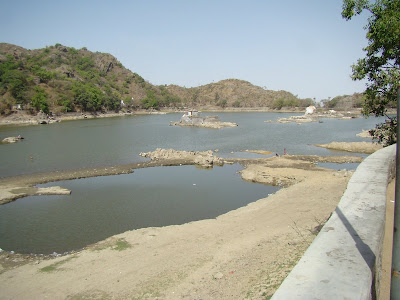
Weeks ago, camera in hand, I stood at its brink, seeking to photograph the Abu I’ve always recognised. However, I found something that was less loud and felt heavier. The water no longer gleams as it used to. Its quietness has transformed. The lake is showing signs of fatigue.
Look at the photographs that follow. They speak more honestly than I can.
And what they say is difficult to see.
 |
| Nakki Lake 29,April 2010 |
 |
| Another View of the Lake |
 |
At a different angle, Nakki Lake 29, April 2010 |
 |
| Pathetic state, at a different angle, Nakki Lake 29, April 2010 |
 |
Gray langur escaping the summer heat |
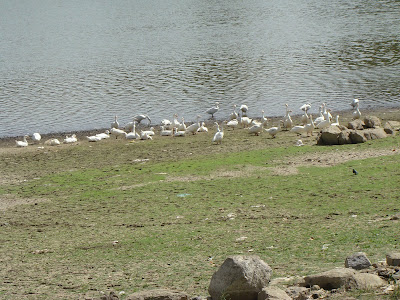 |
| The playing field for the geese at Nakki Lake |
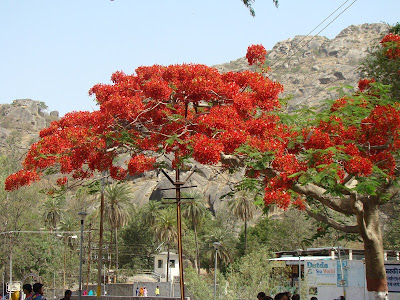 |
| Gulmohar tree at the lake |


Scientifically, i.e.geologically speaking the lake is suspected to be the mouth of a very very old and now extinct volcano. The Abu massif i.e. the Abu hills)is, petrologically speaking, a volcanic extrusion from the depths which is somewhat younger than the Aravalli hills which stretch all the way to Delhi (the ridge in Delhi), hence the term massif - Just some blah-blah for anyone who is interested
ReplyDeleteIts sad to see this state of Nakki Lake. Hope the monsoons are good this year and helps restore the lake to its former glory.
ReplyDeleteWell, they should now be able to catch that croc escaped when Trevor Tal overflowed that prior year of heavy rains!!
ReplyDeleteits no use digging it now,they should have done at an earlier time
ReplyDelete