Search This Blog

Wednesday, July 19, 2023

A update on Mount Abu (4 June 2015)

An unfortunate accident by a drunken driver.

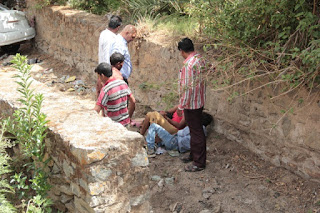
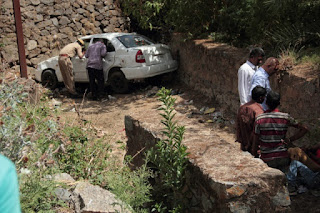
A car from Gujarat a GJ 30 9620 at around 2:45 pm shot off the road and flew into the gutter near the Neel Kant temple. Apparently, the driver and a co-passenger were two sheets in the wind. Fortunately for all the passengers in the car, no one received major injuries. A crowd of Abuites were on the scene within minutes and were of great assistance. The crowd of Abuites immediately pulled the passengers out of the car and provided them with first aid. The locals gathered there and helped put the vehicle, which had turned turtle, back on its wheels. Here are a few snaps of the mishap that took place today.

'A tourist car overshot and landed in the stream, Abuites gathered around to help the passangers.",
A tourist car overshot and landed in the stream

"The tourist car which overshot landed in the stream below."
The tourist car which overshot landed in the stream below

"A cop overseeing the accident spot."
A cop overseeing the accident spot

"A few of the injured tourists pulled out of the car."
A few of the injured tourists pulled out of the car


Wednesday, June 21, 2023

Unprecedented Cyclone Biparjoy Devastates Mount Abu

Mount Abu Survives Its First Cyclone as Nature Takes Over

"The eye of the cyclone over Mount Abu, from Zoom Earth "
The eye of the cyclone over Mount Abu, from Zoom Earth 

A rare weather phenomenon occurred in Mount Abu, Rajasthan's scenic Aravalli Range. Cyclone Biparjoy made an unexpected impact on this landlocked region on June 16, 2023, leaving a trail of destruction in its wake. This unexpected cyclonic storm, which is unusual for Mount Abu, astonished both inhabitants and officials. Despite its distance from the shore, torrential rainfall and powerful gusts hit the town, inflicting extensive damage.

The Ordeal Unleashed: When the Biparjoy hit, Mount Abu was unprepared for the devastation that ensued. With high winds and constant rain, the "Abode of Gods" swiftly became a war against nature's fury. Flash floods swamped the town, submerging homes and streets. The strong winds toppled trees and electricity lines, resembling a heavenly bowling match. Essential services were severely affected, with no power, water, or internet access.
On Saturday, June 17, 2023, the Abuites (the dwellers of Mount Abu) experienced fear as the unrelenting storm showed no signs of abating. It cut residents off from essential services, putting them in an unusual scenario. Their tin-sheeted homes provided little shelter against the chilling winds, resulting in substantial damage and loss of property. It carried away countless birds and their young in the roaring floods, adding to the animal toll.

Record rainfall and lingering hardships resulted from Cyclone Biparjoy's influence, which was felt well beyond Mount Abu. The Banas River overflowed its banks on the lowlands, causing significant flooding on Abu Road. During the disaster, Mount Abu received an incredible 8.4 inches of rain. The event lasted five days and left the Abuites without power, water, or internet access. This unforeseen interruption provided a brutal reality check for a populace that is dependent on modern gadgets, requiring them to reconnect with their natural surroundings.

Rebuilding Lives and Restoring Normalcy: Life on Mount Abu gradually resumes its normalcy. Residents are relieved that they have restored essential services. As the community heals from this unique occurrence, it serves as a reminder of nature's dominant force and the Abuites' perseverance in the face of hardship. Although the cyclone caused significant difficulty, it also provided an opportunity for introspection and appreciation of their surroundings.

Conclusion: Cyclone Biparjoy's unanticipated visit to Mount Abu, a first in the area's meteorological history, left the community reeling from the devastation wreaked by strong winds and unrelenting rainfall. The community came together in the face of this unforeseeable disaster, exhibiting resilience and a sense of togetherness. As life returns to normal, the Abuites begin to repair their houses, grateful for the restoration of critical services. We will inscribe this remarkable occurrence in Mount Abu's history as a monument to the locals' fortitude and tenacity.


Friday, June 02, 2023

The Neglected Lake of Mount Abu: A Cry for Help

Exploring the Enchanting Nakki Lake: A Jewel of Mount Abu.

"Overcast sky over Nakki Lake Mount Abu"
Nakki Lake, Mount Abu.
Photo per kind favour, Harry(Harnam)

"The stagnant green waters of the Nakki Lake when neglected"
Nakki Lake, when neglected, 

Nakki Lake — Reflect Governance


 Oh, Nakki Lake — once a mirror of sky and stone,now a mirror of us.Not of our beauty—but of our decisions. 

Green where you were blue,heavy where you once held light, you do not hide what we have allowed to happen.

These are not new ideas.

They are simply not being applied with consistency.


A Quiet Test of Intent


Oh Nakki Lake,you have become more than a landscape.

You are now a measure—of how seriously we take our own policies,

of whether governance extends beyond announcements,of whether protection can keep pace with promotion.

You do not need grand promises.

You need follow-through.

Because in the end,the state of your waters will not reflect what was planned—but what was actually done.


 A Sacred Lake, Reduced


 There was a time when the Garasia tribe came here in reverence—


to honour ancestors,to recognise some landscapes are not commodities.


 There was a time when the people of Mount Abu understood that.


 Today, that understanding feels distant.


The lake has become scenery—something to be used, not protected.


Growth Without Guardrails


 People encouraged tourism; it did not just arrive.


 Policies promoting hill tourism, expanding access, and increasing visitor footfall have, over the past decade, transformed Mount Abu into a year-round destination. The Rajasthan Tourism Development Corporation has done its job well—bringing people in.

But protection has not kept pace with promotion.


The Mount Abu Municipal Board struggles with a waste collection that is overwhelmed during peak seasons. The Rajasthan State Pollution Control Board sets standards—but enforcement on the ground feels sporadic at best.


 Meanwhile, the Mount Abu Eco Sensitive Zone Monitoring Committee exists to prevent this kind of gradual degradation—yet the lake’s condition suggests that monitoring has not translated into meaningful intervention.

This is not a failure of intent on paper.It is a failure of execution in reality.


 A Lifeline Under Strain


This lake is not ornamental—it is functional.


 When supplies tighten, Mount Abu draws upon Nakki Lake, alongside sources like the Khodra Dam.


 The treatment, filtering, and redistribution of that water prompt an uncomfortable question: if the source is compromised, how much faith can we place in the system that follows?

Water security and environmental health are not separate issues here. They are the same issues.


The Comfort of Visible Work


 There is no shortage of visible effort—pathways improved, railings installed, edges beautified. These are tangible, budgeted, and reportable. But the actual work — controlling inflow of waste, managing sewage, regulating tourist pressure — is less visible, more complex, and far more critical. t is also where progress appears uneven.


Responsibility, Defined


Yes, individuals matter.


A tourist who litters contributes to the problem.


A resident who ignores it allows it to continue.


But institutional responsibility is not optional.


Officials do not enforce regulations that exist, they do not expand capacity that is exceeded, and they do not act upon warnings that are known—which makes responsibility traceable.

Not dramatic.

Not loud.

But undeniable.


What needs to happen now


 Not another announcement.   


Not another cosmetic upgrade.


 What Nakki Lake requires is coordination — between tourism authorities, municipal systems, and environmental regulators.


* Enforced waste management during peak tourist flow


* Regular, transparent water quality monitoring


* Clear limits on ecological load, not just theoretical ones


* Accountability mechanisms that extend beyond paperwork


"Selfie point I love Mount Abu at Nakki Lake"
Selfie point, I love Mount Photo, per kind favour, Harry(Harnam)


"A tourist attraction Boating on the Nakki Lake"
Boating on the Nakki Lake Photo per kind favour Harry(Harnam)

"Nakki Lake strewn with garbage thrown by visitors"
Garbage in the lake Photo per kind favour Harry(Harnam)

"The beauty of the Nakki Lake enhanced by the setting sun"
Nakki Lake at sunset
Photo per kind favour, Harry(Harnam)


Tuesday, May 09, 2023

"Why do politicians and leaders visit Mount Abu and Abu Road in Rajasthan?"

Mount Abu isn’t a backdrop — It’s a political prop.

Rahul Gandhi will probably travel to Mount Abu today.

"Mount Abu City photographed from Achalgarh. a panoramic  view of Mount Abu."
Mount Abu City as seen from Achalgarh.

Let’s drop the pretence. The arrival of leaders in Mount Abu or their passage through Abu Road has nothing to do with the weather, the landscape, or spontaneous spiritual epiphanies. It is about optics, timing, and control of the narrative.

 With reports of Rahul Gandhi visiting the region and Narendra Modi scheduled close behind, the choreography is hard to miss. These are not coincidental trips. Appearances are calculated in a state where all signals are crucial, and all images are deliberately designed.

 The tourism industry presents Mount Abu as Rajasthan’s tranquil hill station, a spot offering cool air and peaceful contemplation. But it functions as something far more convenient: a clean, respectable stage. Stand near the Dilwara Temples, invoke heritage, nod toward spirituality, and the visuals write themselves. Make a stop at the headquarters of the Brahma Kumaris, and the message is softened: peace, values, introspection. It is branding dressed up as belief.

 Then there is Abu Road — less photogenic, more functional, and therefore just as important. It is a gateway town, feeding into the steady human flow toward Ambaji Temple. With high footfall, easy access, and a mix of demographics, this ground allows for quick and efficient political messaging. If Mount Abu offers symbolism, Abu Road offers reach.

 This is how modern politics works. Not through spontaneous connection, but through selected locations that deliver maximum return. A hill station becomes a halo. The temple is becoming a talking point. A roadside gathering becomes “mass outreach.” They dress up the language, but the intent is blunt: visibility equals relevance.

 Rajasthan, with its volatile electoral swings and deep-rooted local dynamics, demands this kind of relentless signalling. No major party can afford to ignore even its quieter corners. But let’s not mistake attention for affection. These visits are not about understanding Mount Abu or Abu Road. They are about using them.

 Because once the speeches are done, the motorcades move on. The traffic clears, the banners come down, and the towns return to their usual concerns — water shortages, forest stress, unmanaged tourism, and infrastructure that keeps pace with promises. None of that makes it into the campaign frame.

 So the next time a leader arrives in Mount Abu or Abu Road, it’s worth asking: who is this visit for? The people who live here — or the cameras that follow?

 In today’s politics, places like Mount Abu are not destinations. They are devices. And the performance lingers once the spotlight shifts.


Saturday, April 08, 2023

Happy Easter from the Abode of the Gods - Mount Abu.

 I wish you an Easter filled with happiness and blessings!
HAPPY EASTER.

"Paschal Full Moon OR PINK MOON decides the date of Easter Sunday."
The Paschal Full Moon Mount Abu.

From the cool heights of Mount Abu, where the Aravallis still hold whispers of spring, may this Easter bring you renewal, quiet joy, and a sense of hope that feels as fresh as the season itself.

Happy Easter.

Easter is not just a date on the calendar—it is a moment shaped by the sky.

The Paschal Full Moon determines Easter’s timing; it’s the first full moon after the spring equinox, falling between March 21 and April 25. This celestial marker sets the date for Easter Sunday annually, linking the festival to faith and the rhythms of nature.

Its origins lie deep in early Christianity, tied to the Jewish festival of Passover. As the crucifixion of Jesus Christ took place during this period, early Christians aligned Easter with the lunar-based calendar. Because Passover is determined by the full moon, Easter too came to follow the moon’s cycle—formalised using the Gregorian calendar we follow today.

Over centuries, Easter has gathered symbols that speak the universal language of spring.

The egg, simple yet profound, has long represented new life and rebirth—its meaning embraced by many cultures long before Christianity, and later woven into its narrative of resurrection.

The Easter Bunny, with origins in Germanic folklore, symbolised fertility and renewal. German immigrants carried this tradition to America in the 18th century, from where it spread, becoming a beloved part of Easter celebrations—especially for children.

Here in Mount Abu, where the rustling leaves and returning birdsong reveal the changing seasons, Easter connects deeply to its roots as a celebration of life’s quiet return, resilience, and fresh starts.

 I hope you fill your Easter not just with tradition, but with meaning.